
Executive Summary: The Death of the System of Record
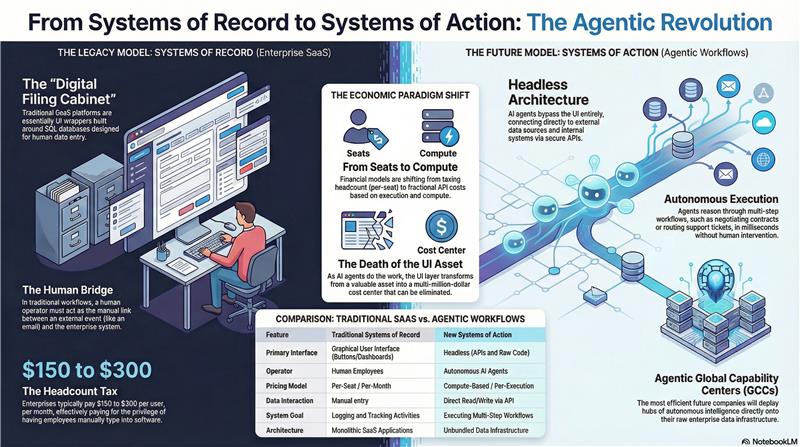
- Traditional enterprise SaaS relies on User Interfaces (UIs) that act as expensive, highly decorated digital filing cabinets.
- Autonomous AI agents render these expensive UI layers obsolete by bypassing screens entirely and connecting directly to external APIs and internal, headless databases.
- Agentic workflows trigger a massive economic paradigm shift, replacing the artificial floor of per-seat licensing costs with hyper-efficient, fractional API compute costs.
- The future of enterprise architecture is "headless"; instead of buying bloated software platforms, companies must unbundle their operations and establish Agentic Global Capability Centers (GCCs).
For the last twenty years, the enterprise technology sector has been built on a single, unchallenged assumption: to manage data and enterprise workflows, humans need a User Interface.
We bought Customer Relationship Management (CRM) platforms so salespeople could log activities. We bought Enterprise Resource Planning (ERP) systems so procurement could track inventory. We bought Human Capital Management (HCM) tools to track employees.
We called these the "Systems of Record." Over time, we convinced ourselves that these massive, monolithic SaaS applications were the backbone of enterprise operations.
We were wrong.
We were not buying operations. We were buying highly decorated digital filing cabinets.
Enterprise SaaS is, at its core, a User Interface (UI) wrapper built around a SQL database. In the era of Agentic AI and autonomous enterprise automation, the UI layer is no longer an asset. It is a multi-million-dollar cost center.
Exposing the SaaS Illusion: The Multi-Million-Dollar UI Trap
Look at your enterprise software bill. You are likely paying $150 to $300 per user, per month, for your primary System of Record.
What are you actually paying for? The storage of enterprise data costs fractions of a penny. The compute is negligible. You are paying for the buttons, the drop-down menus, the dashboards, and the privilege of having employees spend a significant portion of their day manually typing information into enterprise systems.
In a traditional enterprise workflow, a human operator acts as the bridge between an external event, such as an email from a lead or a quote from a vendor, and the System of Record. The UI was necessary because humans cannot read and write raw code directly to a database efficiently.
But AI agents do not have eyes. They do not use a mouse. They do not need dashboards.
Bypassing the Interface: The Power of the Agentic Workflow
As we move past simple chatbots and into autonomous AI agents capable of reasoning, using tools, and executing multi step enterprise workflows, the architecture of work fundamentally changes.
When an AI agent is tasked with generating leads, negotiating a vendor contract, or routing a customer support ticket, it does not log in to Salesforce or Coupa. It bypasses the UI entirely.
The agent connects directly to external data sources such as APIs, email servers, and structured databases, reasons through the logic, and then reads or writes directly to internal enterprise systems through secure API integrations.
In an agentic workflow, the $150 per user CRM is functionally indistinguishable from a raw, headless PostgreSQL database.
If agents are doing the work, the System of Record loses its meaning. It ceases to be an application. It reverts to what it always was: pure enterprise data.
The Economic Paradigm Shift
For Private Equity firms and enterprise CEOs, this is a moment of financial disruption.
The traditional SaaS model relies on per seat licensing. It taxes headcount. The more humans interacting with enterprise software, the more the vendor makes. This creates an artificial floor on operational expenses.
Agentic workflows remove this floor. By eliminating the UI and connecting intelligence directly to the database, organizations shift from per seat licensing to compute based execution.
Instead of paying a BPO or offshore team to manually transfer data between screens, and paying a SaaS vendor for the screens themselves, enterprises pay fractional API compute costs for autonomous agents to execute tasks in milliseconds.
The Future Is Headless
Consulting firms will try to sell multiyear digital transformation programs to migrate you from one bloated System of Record to another. They will design user journeys for software your workforce may not need to use.
The most efficient companies of the next decade will not buy more enterprise software. They will unbundle it.
They will establish Agentic Global Capability Centers (GCCs), hubs of autonomous intelligence deployed directly onto enterprise data infrastructure. They will stop managing software platforms and start managing agent-driven execution.
The System of Record is dead. Welcome to the System of Action.
Frequently Asked Questions

Co-Founder - AI Strategy & Implementation
Manoj leads AI strategy and enterprise implementation initiatives, helping organizations adopt AI through structured planning and scalable deployment frameworks. He works closely with C-suite leaders to align AI initiatives with business goals, ensuring measurable ROI and long-term value creation.